On this page
- Tattoo government job rules in Malaysia: documented vs reported
- Tattoo and police in Malaysia: the 2017 Bukit Aman notice
- Armed forces (ATM): what recruitment guides say
- Civil service (JPA and SPA): no published tattoo rule found
- Tattoo at work in Malaysia: private sector norms
- Visible vs hidden placements
- Covering a tattoo for an interview
- Removing a tattoo before you apply
- Before you ink: a five-step check
- Frequently asked questions
Quick answer
Can you get a government job in Malaysia with a tattoo? It depends on the service. The police (PDRM) issued a notice in 2017 saying officers may not have tattoos. For the army, "no tattoos" appears only in third-party recruitment guides. For the wider civil service, we found no published tattoo rule. So check the current notice for your exact post before you get inked.
If you are asking about a tattoo government job Malaysia rule, you will find plenty of forum posts and very few official documents. That gap matters, because a tattoo is permanent and a career plan is long. In this guide we separate three things: rules an agency has published, rules that only news reports describe, and topics where we simply found nothing. We checked official portals on 16 October 2026 and say clearly where a source is weak.
Nothing here is legal or career advice. Instead, treat it as a map of what exists, so you know which questions to ask a recruiter before you book a session.
Tattoo government job rules in Malaysia: documented vs reported
First, here is the short version of every tattoo and government job rule in Malaysia we could trace, in one table. "Documented" means we read it in an official notice or a news report of an official notice. "Reported" means the claim comes from a third party, such as a recruitment blog.
| Employer | What we found | Strength of source |
|---|---|---|
| Police (PDRM) | Bukit Aman notice of 21 June 2017: police officers may not have tattoos | Reported by the press; current rule text not found on the official site |
| Armed forces (ATM) | "Tidak bertatu" (no tattoos) listed for army recruit intakes | Third-party recruitment guides only |
| Civil service (JPA / SPA) | No tattoo rule in the general application conditions we checked | Official portal checked; no rule found |
| Private employers | No Malaysian law found that bans tattoos at work | Each employer sets its own dress code |
Tattoo and police in Malaysia: the 2017 Bukit Aman notice
The clearest public rule comes from the police. In July 2017, SAYS reported that Bukit Aman had issued a notice dated 21 June 2017. According to the report, police officers may not have tattoos. The news first surfaced through Oriental Daily, which quoted an Ipoh deputy district police chief.
The reasons given in the coverage were image and uniformity. In addition, the report linked tattoos to concerns about gang membership. However, the article did not say what happens to officers who already had tattoos, or whether they must remove them.
What about religious or traditional tattoos?
Here the picture gets murky. In 2014, the then Miri police chief said religious or traditional tattoos could be allowed if they were not heavily visible. He said the banned kind were tattoos linked to gangsterism or with sadistic or obscene motives. That comment came three years before the 2017 notice, though. As a result, nobody should assume it still applies. Bornean applicants with traditional work, such as a bunga terung or other Iban motif, should ask the recruitment office directly.
We could not find the current tattoo rule on the official PDRM site or its e-recruitment pages. The 2017 notice may have changed since. Before you apply, ask the recruitment unit in writing and keep the reply.
Armed forces (ATM): what recruitment guides say
For the army, the trail is thinner. Several Malaysian recruitment blogs list "Tidak bertatu" among the requirements for the Perajurit Muda Tentera Darat intake. For example, one guide published in June 2026 includes it for the 2026 intake. However, we could not confirm the line on the official armed forces or defence ministry recruitment portals. One portal we tried returned an error page on the day we checked.
So treat "no tattoos" for the army as likely, but unconfirmed. The same applies to the navy and air force, where we found no specific source at all. If a uniformed government job in Malaysia is a real possibility for you, the safe choice is simple: hold off on the tattoo until you have your offer and the written rules.
Civil service (JPA and SPA): no published tattoo rule found
Most government jobs in Malaysia sit in the wider civil service, not in uniform, so this is where most tattoo questions land. Here we looked at the Suruhanjaya Perkhidmatan Awam (SPA) portal, which handles many civil service applications. Its general conditions cover citizenship, a minimum age of 18, probation and training. On 16 October 2026, those conditions said nothing about tattoos, appearance or a medical check.
We also found no Jabatan Perkhidmatan Awam (JPA) document that bans tattoos for civil servants. That said, "not found" is not the same as "allowed". Individual schemes, departments and dress codes can add their own expectations. Also, interview panels may form a view of visible tattoos even without a written rule. In short, nobody has published a blanket tattoo ban for government jobs in Malaysia, but you should still ask about your specific scheme.
Some applicants also weigh religious guidance. The national fatwa committee considers tattooing forbidden for Muslims, and our guide on whether tattoos are legal in Malaysia sets out those positions neutrally. Those are religious rulings, not civil service employment rules.
Tattoo at work in Malaysia: private sector norms
Outside a government job, the tattoo question in Malaysia changes. We found no Malaysian law that stops a private employer from hiring someone with a tattoo. Equally, we found none that stops an employer from setting a grooming policy. Therefore the answer depends on the company, the role and how visible the tattoo is.
Customer-facing, hospitality and banking roles
Roles with a uniform or a formal dress code tend to raise the most questions. These include bank branches, hotel front desks, airline cabin crew and corporate client work. Some employers ask staff to cover tattoos; others do not mind. Because these policies are internal, they rarely appear online. The practical step is to ask HR for the grooming guidelines once you reach the interview stage.
Creative, tech and trade roles
By contrast, many creative agencies, tech firms, F&B outlets and trade workshops pay little attention to tattoos. Even so, client-facing days can come with stricter expectations. A tattoo you can cover with a long-sleeved shirt keeps your options open in almost any job.
Visible vs hidden placements
If you want a tattoo and a flexible career, placement matters more than design. The table below shows how easy each area is to hide with typical Malaysian work clothes, such as a long-sleeved shirt, baju kurung or trousers.
| Placement | Covered by office wear? | Notes |
|---|---|---|
| Upper arm, shoulder, back, chest, ribs | Yes | Hidden by almost any shirt |
| Thigh, calf | Yes | Visible in shorts or sports kit |
| Inner forearm, wrist | Partly | Shows when sleeves ride up |
| Ankle, foot | Partly | Shows with sandals or when you remove shoes |
| Neck, behind the ear | Rarely | Collars hide only the lowest part |
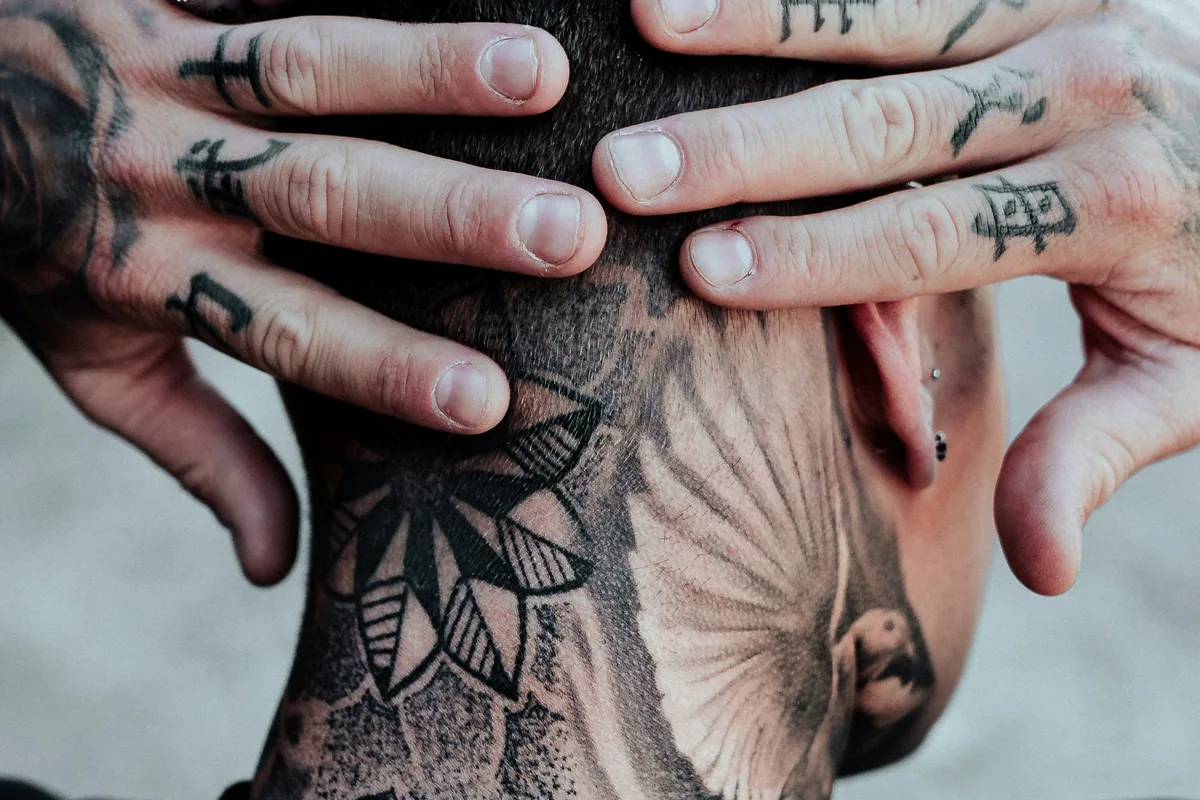
| Hands, fingers, face | No | Always visible; hardest to hide at interviews |
Small pieces fit easily in hidden spots. For ideas, see our guides to small tattoo ideas and planning a first tattoo.
Covering a tattoo for an interview
If you already have visible ink, you have several simple options. First, clothing does most of the work. A long-sleeved shirt or blouse covers arm pieces, and a high collar helps with lower neck work. Next, for wrists and hands, skin-tone tattoo cover concealers can hide small pieces for a few hours. Test them at home first, because Malaysian heat and humidity can make make-up slide.
Also, avoid covering a fresh tattoo. A healing tattoo needs air and gentle care, so plan any new ink well away from interview dates. Our guide to healing a tattoo in Malaysia's humidity explains why tight sleeves and sweat slow healing.
Removing a tattoo before you apply
Some people with a government job offer in Malaysia decide on removal. If so, start early, because laser removal is slow. DermNet says most tattoos need 5 to 12 treatments at 6 to 8-week intervals, and full clearance is not always possible. In other words, removal can take from about seven months to nearly two years.
In Malaysia, laser removal counts as a medical procedure, so book with a doctor-led clinic, not a beauty centre. Clinic prices we found range from about RM200 to RM2,500 per session, depending on size, colour and the laser. Confirm the full plan and price before you start. Our tattoo removal guide and removal price guide cover clinics, sessions and costs in detail.
A cover-up is another route for private sector jobs, but it does not help if your target role bans all tattoos. See our cover-up guide for when that option makes sense.
Before you ink: a five-step check
- Name the job you might wantAny tattoo decision in Malaysia that touches a government job starts here. Write down the services you could apply to in the next five to ten years, such as police, army, customs or a bank.
- Find the official noticeLook for the current recruitment advert or requirement list on the agency's own site, not a blog.
- Ask in writingIf the notice is silent, email the recruitment unit and ask about tattoos, size and placement.
- Choose a hidden placementIf you go ahead, pick an area a standard shirt covers, such as the upper arm or back.
- Brief your artistTell your artist about your plans so they can suggest size and placement. Our guide on how to choose a tattoo artist lists questions to ask.
Frequently asked questions
Can I join the police in Malaysia if I have a tattoo?
A Bukit Aman notice dated 21 June 2017, reported by the press, said police officers may not have tattoos. We could not find the current rule on the official PDRM site, so ask the recruitment unit before you apply.
Does the Malaysian army accept people with tattoos?
Third-party recruitment guides list "tidak bertatu" (no tattoos) for army recruit intakes. We could not confirm this on an official armed forces portal. Treat it as likely but unconfirmed, and check the official advert.
Can civil servants in Malaysia have tattoos?
We found no published JPA or SPA rule that bans tattoos for civil servants. The general SPA application conditions do not mention tattoos. However, individual schemes and departments may have their own expectations, so ask about your specific post.
Are tattoos allowed at work in Malaysia?
We found no Malaysian law that bans tattoos at private workplaces. Each employer sets its own dress code. Customer-facing roles such as banking and hotels are more likely to ask you to cover up.
Will a small hidden tattoo affect a government job?
It might in services with a strict no-tattoo rule, because medical or physical checks can reveal it. In the wider civil service, we found no published rule. A hidden placement keeps more doors open, but it does not guarantee anything.
How long does tattoo removal take before a job application?
DermNet says most tattoos need 5 to 12 laser sessions spaced 6 to 8 weeks apart. That works out at roughly seven months to nearly two years, and some ink never fully clears.